
Kitchen Sink Drain Placement: Center vs. Rear Explained

Kitchen planning · Bowl and cabinet layout
Kitchen Sink Drain Placement: Center vs. Rear Explained
Kitchen sink drain placement affects where you can set cookware and how plumbing may occupy the cabinet below. A centered drain sits closer to the middle of the bowl, while a rear-positioned drain moves the opening toward the back. Neither location is automatically best: compare the bowl layout, your washing routine, and the actual plumbing arrangement.
Quick answer: inspect above and below the sink
Choose a drain location that works with your largest everyday cookware, then have your installer check the drain assembly, disposal if used, and wall connection. A promising top view is only half of the decision.
Use the pre-purchase checklistCenter, Rear-Center, and Rear-Offset: Know the Difference
Drain-location labels are not always used in exactly the same way. “Offset” tells you the opening is displaced from a reference point, but it does not necessarily tell you which direction. Check an overhead drawing to locate the opening relative to the front, back, and sides of the selected basin.
| Location | Typical description | What to compare |
|---|---|---|
| Center | Opening near the middle of the bowl floor | Where a large pot rests and where the assembly hangs below |
| Rear-center | Opening toward the back, roughly centered side to side | Space in front of the drain and access for cleaning |
| Rear-offset | Opening toward the back and displaced to one side | The chosen orientation and its relationship to plumbing and storage |
Use the drawing, not the name alone, to compare two models. On a double-bowl sink, identify the drain in each bowl and the divider arrangement. The same location label can describe very different working spaces in a large single basin and a smaller divided basin.
How Drain Placement Can Affect Washing Up
Think About Where Your Largest Pan Will Sit
A rear-positioned drain may leave a useful area of basin floor in front of the opening. Whether that helps you depends on the bowl and the item you are washing. Measure a roasting pan or stockpot, including its handles, and compare it with the interior dimensions rather than the sink's exterior width.
Do not expect location alone to stop a flat item from obstructing water flow. A large tray can still span an opening or restrict the route water takes around it. Consider how you will hold, rinse, and reposition the item during use.
Check Access to the Strainer or Stopper
Ask whether you can comfortably reach the drain while the bowl contains the items you normally wash. Think about removing a strainer basket, operating a stopper, and lifting out a fitted bottom grid. A photograph with an empty bowl does not demonstrate those tasks.
For example, someone who regularly soaks a wide pan might want space to lift the strainer without moving the pan first. Another household may prioritize a familiar arrangement when replacing an existing sink. These are planning examples, not measured performance comparisons.
Will a Rear Drain Create More Cabinet Storage?
Moving the drain can change where the connected components sit. Manufacturers sometimes describe rear-offset designs as providing additional usable space below the basin. That is a reason to examine the layout, not a guarantee that your cabinet will gain a specific storage volume.
Have your installer review the complete assembly: the drain fitting, trap, wall connection, and any disposal, filtration equipment, or pullout storage you plan to use. Components may occupy different areas even when the drain opening moves toward the back.
Plan the Storage Item, Not Just Empty Space
If you want a pullout waste bin, note its dimensions and travel. If you want cleaning-product storage, sketch the shelf or organizer. Check those items against the proposed installed plumbing rather than assuming a clear rectangle in the cabinet will stay clear.
Do not relocate plumbing yourself to create storage clearance. Ask an appropriate professional to assess the work and any local requirements. This guide compares purchasing considerations; it is not a plumbing installation procedure.
Does a Rear Drain Always Empty Faster?
No reliable speed comparison follows from location alone. Basin shape, slope, drain components, obstructions, and the connected plumbing all matter. An offset opening is not proof that a sink will avoid every puddle, clog, or cleaning task.
Look for the selected model's specification and care instructions. If an existing sink drains slowly, changing the basin layout should not be your first diagnosis. Have the strainer, connected plumbing, and installation assessed before attributing the problem to a centered or rear drain.
Five Checks Before You Choose
- Locate the opening on a drawing. Confirm which direction “offset” means and whether orientation affects installation.
- Compare the interior bowl. Check the largest item you expect to wash, not just the advertised overall size.
- Review the components below. Give your installer the proposed sink, drain, and disposal details if applicable.
- Test the storage plan. Include drawer movement, bin dimensions, service access, and existing cabinet features.
- Confirm the replacement requirements. Review the countertop opening, support, mounting type, and wall connection before buying.
Keeping your current countertop?
A replacement needs to suit the existing opening as well as the plumbing. A similar exterior width does not establish fit, and a new drain position may need connection changes. Ask your installer to review the exact model first.
Ask about a selected Lordear modelA Lordear Offset-Drain Model to Review
The Lordear 33-inch drop-in granite composite workstation sink, model FBA-L-G0o1-TSr33B, lists a 3½-inch offset drain opening. Its dimensions section gives an exterior footprint of 33 × 22 inches, an overall height of 9⅝ inches, and a 36-inch minimum cabinet requirement.
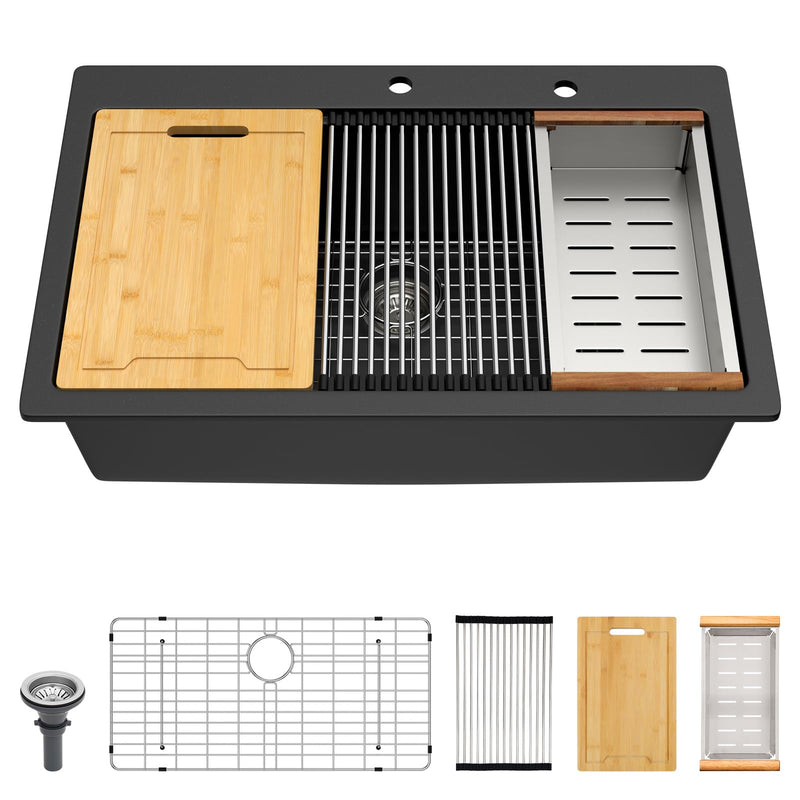
Use those details to identify the candidate, then confirm the opening's exact location on the current model drawing. The word “offset” does not establish a specific rear or side orientation. The listed drain-opening size also does not by itself confirm the fit of every disposal or existing connection.
Compare alternatives in the Lordear kitchen sink collection or the drop-in sink collection. If you are exploring the broader subject, the existing kitchen drain-placement article provides related context; use the individual product's documents for purchase and installation decisions.
Frequently Asked Questions
Is a center drain worse than an offset drain?
Not automatically. Compare the usable bowl, your cookware, and the installed plumbing. A familiar center layout may work well for your routine, while an offset layout may suit another project.
Does offset always mean rear-right?
No. Confirm the opening on the model drawing. Product labels can use “offset” without specifying a rear, left, or right position.
Can I reuse my garbage disposal?
Have the installer check the sink opening, mounting arrangement, disposal model, and connection heights. A common drain diameter is only one part of compatibility.
Can a new drain position solve a slow-draining sink?
Do not assume so. Diagnose the existing drainage problem first. A different opening location does not remove an obstruction or correct every plumbing issue.
Choose a Layout You Can Verify
Compare drain placement from two views: how you will use the basin and how the components will fit below it. Save the model drawing and have the full arrangement reviewed before ordering. If you need product information, send Lordear your model and fit questions as the next step.